Empowering Tomorrow’s Doctors
The MDT gives healthcare trainees an on-demand, voice-based AI patient and examiner for realistic spoken practice and immediate structured feedback.
Trusted by healthcare professionals
Real feedback from clinicians and learners who have used The MDT.
❝
“The AI patient responses are surprisingly nuanced… content is authentic, the flow is smooth and prompts mirrored real ward questions.”
Dr Bidisha Ghosh
Consultant Obstetrician & Gynaecologist College Tutor
❝
“What sets it apart is its meticulous attention to clinical accuracy, alignment with examination blueprints, and remarkably natural conversational flow.”
Dr Aaron Murugasu
Anaesthetics Registrar
❝
“The programme is both user friendly and supports students as they prepare for their exams… the personalised feedback encourages self-reflection and helps targeted learning.”
Ms Suneetha Ganta
Consultant
Clinical Placement Supervisor & Academic Advisor
Practise the conversation. Get the feedback. Improve.
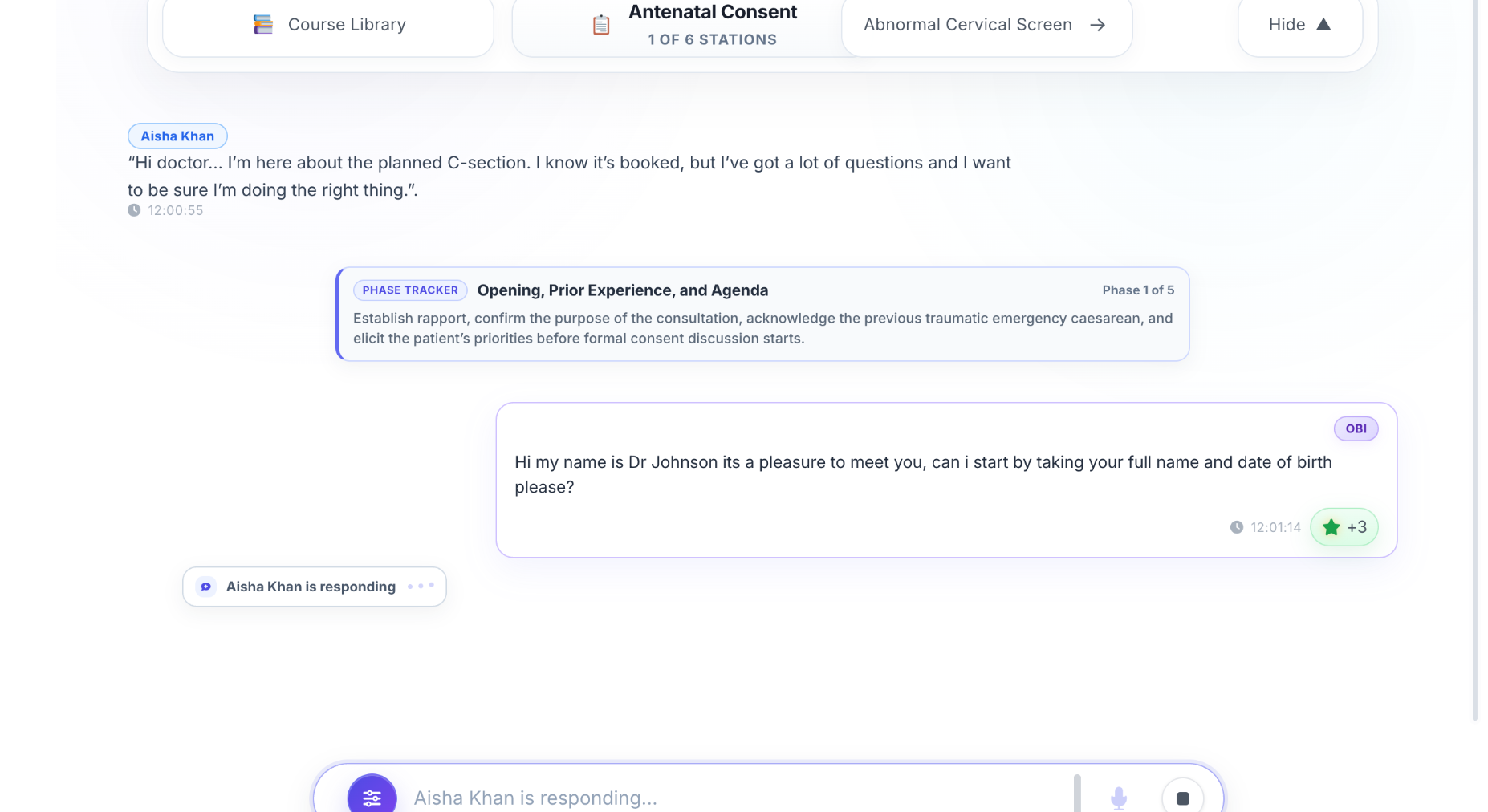
Choose a clinical scenario, speak naturally to an AI patient, and receive structured feedback on what you did well, what you missed and what to work on next.
01
Speak naturally
Use voice or text with an AI patient that responds as the conversation unfolds.
02
Practise with guidance
Practice mode shows phase goals and recognises progress as you work.
03
Know what to improve
Finish with structured feedback, your transcript and a checklist of what you achieved and missed.
Tested. Measured. Improved.
Backed by £5,000 of Pankhurst funding, The MDT was tested across O&G and midwifery with human examiners, paired AI comparisons and structured candidate feedback — every finding now shaping V2.
2026 CLINICAL PILOT
£5K
Externally funded pilot
12
Clinical scenarios
28
Human–AI comparisons
+70
Pilot NPS
Built from feedback, not assumptions.
The pilot showed us where the simulator was strong — and exactly where it needed to improve. Those findings directly shaped V2.
More nuanced marking
Pilot calibration led us to rebuild partial-credit and safety logic for more nuanced, clinically meaningful feedback.
Cleaner exam experience
Candidate feedback drove a simpler, less distracting live-station interface.
Stronger clinical scenarios
Stations, prompts and feedback were reinforced using real candidate and examiner behaviour.
From station brief to final feedback.
Realistic vignettes, clinical documents, images and scans shape the consultation — then every attempt ends with structured feedback and a reviewable transcript.
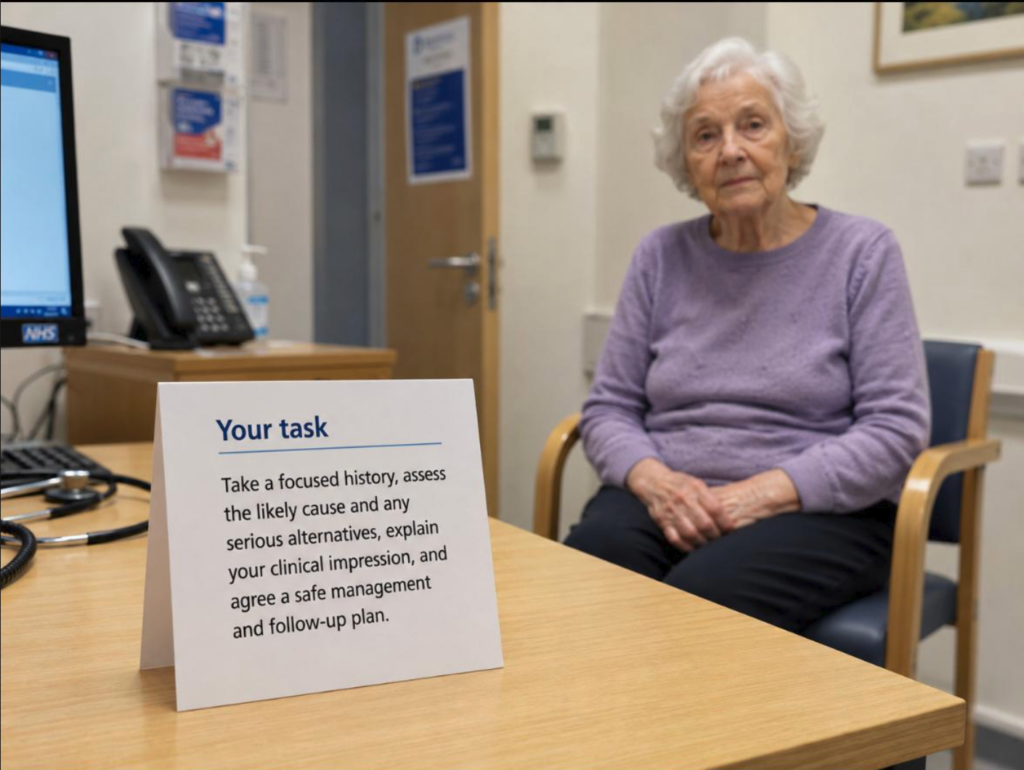
MEET THE PATIENT
More than a text prompt.
Each station starts with a patient, a clinical task and the information you need to understand the situation before the consultation begins.
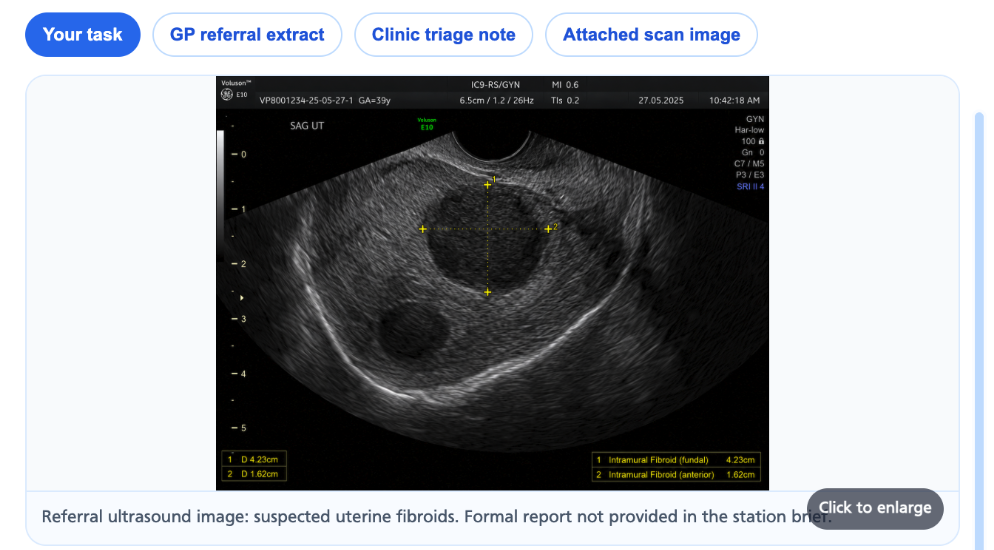
REVIEW THE EVIDENCE
Work with real clinical information.
Scans, referral letters, clinical notes and supporting documents sit inside the station — so you have to interpret the evidence and use it in the consultation.
STATION BRIEF
You are the O&G ST3 registrar in an outpatient gynaecology bleeding clinic. Conduct a focused consultation, work out the clinically important issues from the information available, and agree an appropriate plan with the patient.